Transform AI experiments into measurable business impact.
Most organizations are stuck in endless experimentation. The AI Operating Model provides the complete operating system—from data foundation to team enablement—that successful AI implementation requires.
Most organizations are stuck between AI experimentation and real business impact.
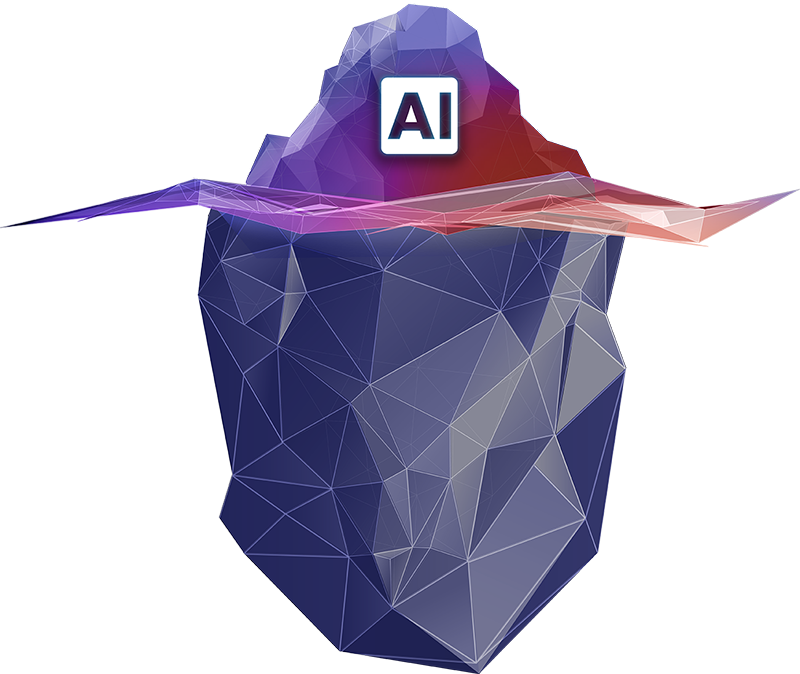
Companies launch pilot after pilot, invest in cutting-edge tools, and hire talented data scientists—but without addressing the full spectrum of requirements from data infrastructure to governance frameworks to adoption enablement, these initiatives rarely scale beyond proof of concept. The result is scattered AI experiments that consume resources without delivering ROI, purchased platforms that sit unused, and teams frustrated by slow progress. This challenge has become so common that it’s created a new category of business risk: the million-dollar mistake of implementing AI without the operating system to support it. The hidden complexity is what we call The AI Iceberg.
Everyone's talking about AI's transformative potential.
Intelligent automation. Predictive insights. Personalized customer experiences. The potential seems limitless, and organizations are investing accordingly—88% now use AI regularly across their operations. But there’s a significant gap between adoption and impact.
Here's the uncomfortable truth: most AI initiatives never deliver.
The exciting use cases get funded. Talented teams are assembled. Proof-of-concept projects show promise. Yet when it’s time to scale, most initiatives stall. Pilots that worked in controlled environments struggle in production. Purchased platforms sit unused. Teams can’t explain why AI recommendations should be trusted. Sound familiar?
The problem? Organizations skip the foundation.
The visible part of AI—the algorithms, the dashboards, the chatbots—represents only a fraction of what’s required for success. Below the surface lie critical foundational elements that determine whether AI initiatives will scale or stall: data quality and infrastructure, governance frameworks, team capabilities, adoption strategies, and development practices. Skip these foundations, and even the most sophisticated AI will fail to deliver business value.
That's why we built the AI Operating Model.
The AI Operating Model emerged from years of helping organizations bridge the gap between AI experimentation and scaled implementation. Rather than focusing on isolated components—strategy, technology, or organizational design—we address the complete operating system required for AI success. It’s structured around our core philosophy: People, Process, and Technology working together to turn scattered initiatives into systematic paths to ROI.
Eight pillars turn promise into performance.
The framework addresses everything from talent strategy and governance to data infrastructure and development practices. Each pillar strengthens the others, creating a comprehensive operating model rather than disconnected initiatives. Whether you’re addressing specific gaps in your current approach or building from the ground up, these eight pillars provide a clear roadmap from pilot to production to measurable business outcomes.
The result? AI that actually works in the real world.
The difference is measurable. Teams move from endless experimentation to systematic delivery. Time from concept to production drops significantly. Most importantly, AI investments translate into tangible business results—cost reductions, revenue growth, operational efficiency, and genuine competitive advantage. That’s what happens when you build on solid ground.
A comprehensive framework built for AI success.
The AI Operating Model organizes critical capabilities into eight interconnected pillars. Each addresses a specific dimension of AI readiness, and together they create the complete operating system your organization needs to move from experimentation to scaled impact.
Strategy & Impact
Aligning AI initiatives with business goals, creating a clear roadmap, and continuously demonstrating measurable business impact.
Data Ecosystem
Building the data infrastructure, quality standards, and governance needed to power effective AI solutions.
Technology Infrastructure
Providing the platforms, computing resources, and integration capabilities that enable AI development and deployment.
Development & Delivery
Building AI solutions from prototype to production with proven software development practices and deployment strategies.
Talent & Resourcing Strategy
Building the right team through strategic decisions about internal capabilities, external partnerships, and ongoing skill development.
Adoption & Enablement
Equipping everyone in the organization—from executives to end users—with the knowledge and support to embrace AI effectively.
Governance & Ethics
Establishing oversight, ethical guidelines, security, and risk management to ensure responsible and compliant AI use.
Innovation & Experimentation
Installing the systematic process, validation frameworks, and innovation culture needed to deliver predictable business results.
A comprehensive framework for sustainable AI success
Three ways to begin strengthening your AI foundation.
Whether you’re addressing specific gaps or building a comprehensive operating model, we meet you where you are. Each entry point delivers immediate value while creating momentum for long-term success.
Begin with strategy
Assess your current state across all eight pillars, identify your biggest gaps and opportunities, and create a prioritized implementation plan. Perfect for organizations ready to move beyond ad-hoc pilots toward systematic AI implementation.
Begin with data
Evaluate your data quality, accessibility, and infrastructure to determine readiness for AI initiatives. Identify specific improvements needed and create an actionable plan to address gaps. Essential groundwork before investing in AI solutions.
Begin with an idea
Test a specific AI use case quickly to prove viability and business value. We build a working prototype, evaluate technical feasibility, and identify what’s required to move to production. Ideal for demonstrating AI potential while uncovering foundational gaps.
Bottleneck Removed with AI-Enabled Micro Applications
A life sciences consulting firm partnered with Mutually Human to speed up research-driven presentations. AI-powered micro applications reduced manual effort while improving accuracy, governance, and scalability.
From Manual Financial Reporting to a Scalable Fabric-Powered Intelligence Platform
A mid-sized construction organization partnered with Mutually Human to modernize financial and project reporting. By automating data pipelines, centralizing financial data in Microsoft Fabric, and replacing spreadsheet-driven processes with governed analytics, the organization gained faster access to trusted insights, reduced manual effort, and built a scalable foundation for future growth and advanced analytics.
A medical manufacturing organization partnered with Mutually Human to scale its analytics capabilities without increasing internal headcount. Through a flexible pod model, we delivered senior-level data engineering, business intelligence, and analytics support—improving reporting consistency, accelerating insights, and establishing a scalable analytics foundation for future growth.
Turning Pricing Chaos into a Scalable Growth Engine
A growing transportation and logistics organization partnered with Mutually Human to modernize its pricing operations. By centralizing data, embedding governance, and designing a custom pricing and analytics solution aligned to real workflows, the organization gained faster insights, improved pricing confidence, and a scalable foundation for revenue and margin growth.
Driving Retail Growth with Microsoft Fabric: Unified Data, Better Insights, Bigger Savings
A leading retailer partnered with Mutually Human to unify fragmented sales, inventory, and customer data using Microsoft Fabric. The new platform delivered real-time insights, improved inventory management, and empowered teams with AI-ready analytics—driving smarter purchasing, stronger supplier negotiations, and faster decision-making across the business.
AI Recipe Optimization Enhances Paint Line Performance
Faced with rising scrap rates and inconsistent product quality, a Tier 2 automotive manufacturer needed a better way to manage complex paint line settings. With over 25 unpredictable variables in play, manual adjustments led to frequent delays and material waste. Mutually Human developed a custom AI-powered recipe optimization solution that automated real-time adjustments—cutting scrap, improving consistency, and enhancing overall equipment effectiveness (OEE).
Article • Artificial Intelligence • Business Intelligence • Customer experience • Data Analytics • Data Management
Healthcare’s Data Challenge: Why Fragmented Systems Are Holding Back Patient Outcomes
Disconnected systems make it harder for providers to deliver quality care. Learn how Microsoft Fabric helps healthcare organizations unify their data, reduce costs, and improve…
Article • Artificial Intelligence • Business Intelligence • Data Analytics • Data Management
The Total Cost of Ownership: Microsoft Fabric vs. Legacy Data Platforms
Licensing costs are just the beginning. This article explores the total cost of ownership—comparing Microsoft Fabric to legacy data platforms across infrastructure, operations, governance, and…
Article • Artificial Intelligence • Business Intelligence • Data Analytics • Data Management
Predictive Maintenance with Microsoft Fabric: A Manufacturing Case Study
A global manufacturer had the data—but not the visibility. With Microsoft Fabric, they unified siloed systems, enabled predictive maintenance, and reduced downtime by 32%. This…
Article • Artificial Intelligence • Business Intelligence • Data Analytics • Data Management
Microsoft Fabric Implementation Options: Jumpstart Programs vs. Phased Approaches
Choosing how to implement Microsoft Fabric is just as important as choosing the platform itself. Explore the differences between Jumpstart programs, phased rollouts, and hybrid…